 Meta

 GoogleAvailable
Model · 22:00
AlphaGenome by Google DeepMind
Google DeepMind's AlphaGenome evaluates 1 million base pair DNA sequences to make thousands of predictions, helping scientists identify disease-causing genetic changes.
Loading launches from 4 labs
GoogleAvailableGoogle DeepMind's AlphaGenome evaluates 1 million base pair DNA sequences to make thousands of predictions, helping scientists identify disease-causing genetic changes.
GoogleAvailableGoogle DeepMind introduced AlphaGenome Atlas, a dataset predicting outcomes of 9 billion single-letter DNA changes to help researchers prioritize variants using an impact score.
OpenAI expanded its ChatGPT for Academic Researchers program to give 200,000 researchers worldwide free access to its frontier models.
OpenAI updated ChatGPT for Healthcare to include improved clinical answers, providing better responses for medical queries.
GoogleAvailableGoogle DeepMind launched AlphaGenome 2, a model that predicts how genetic variants disrupt individual cell types instead of whole tissues.
 GooglePreview
Google Cloud launched Gemini for healthcare, an AI platform that connects clinical, operational, and administrative systems to handle tasks like medical records synthesis and prior authorization review.
OpenAI released BioBasicsBench, a 100-task benchmark to evaluate how well AI agents interpret raw experimental data and perform everyday wet-lab science tasks.
 GoogleAnnounced
Google introduced Antigravity and Cheminformatics Skills for agentic cheminformatics. They are designed to speed up drug discovery workflows, search compounds, and propose novel rigidified macrocycles.
OpenAI launched GPT-6 Rosalind, a model tailored for life sciences research that combines biological reasoning with scientific tool use.
 GoogleAvailable
Google launched visual, interactive explorations in the Gemini app for studying complex science and history topics layer-by-layer.
 GoogleAvailable
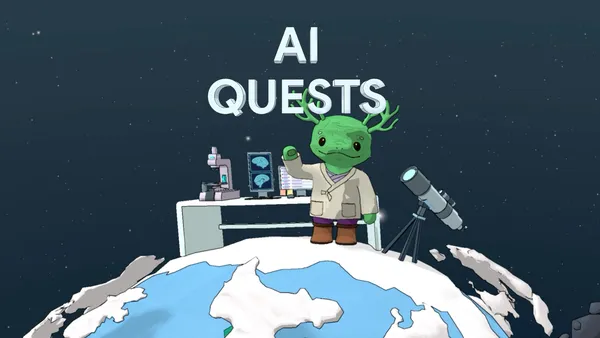
Google released teacher training modules in the Google AI Educator Series to support its AI Quests program. The modules help educators integrate AI literacy lessons into existing curricula and guide classroom discussion.
GoogleAvailableGoogle Research and the Stanford Accelerator for Learning launched Polar Peaks, an interactive AI quest for ages 11 to 14. Students learn AI literacy and human oversight by mapping brain neurons.
OpenAI introduced computer-use agents designed to work across healthcare software to handle real operational and clinical tasks.